
Does Whole House Filtration Remove PFAS & Heavy Metals?

Updated: 4 days ago
Table of Contents
Last Updated: September 30, 2026
What Whole House Filtration Can and Cannot Remove
The short answer: it depends entirely on the filtration media inside the system, not the fact that it's installed at the main water line. A whole house filtration system can reduce PFAS and heavy metals, but only when it contains media specifically rated for those contaminants, verified by independent testing. Many homeowners assume any whole-house unit handles everything. That assumption leads to false confidence. This guide from Bevilacqua Pure breaks down exactly which technologies remove what, how to verify certification claims, and where whole-house treatment falls short compared to point-of-use systems.
PFAS (perfluoroalkyl and polyfluoroalkyl substances) are a family of thousands of synthetic chemicals used since the 1940s in nonstick coatings, food packaging, and firefighting foam. They resist breaking down in the environment and in the human body, which is why they're called "forever chemicals."
Heavy metals are naturally occurring elements like lead, arsenic, and chromium that can enter water through corroded pipes or industrial runoff.
The two contaminant groups behave differently in water, and that difference determines what kind of filter actually works.
How PFAS and Heavy Metals Differ
PFAS molecules are long carbon chains with a fluorine coating. They're attracted to carbon surfaces, which is why activated carbon adsorbs them effectively. Heavy metals are dissolved ions carrying an electrical charge. They respond to ion exchange resin, where charged resin beads swap harmless ions for metal ions, or to reverse osmosis membranes that physically block them.
A single filtration stage rarely handles both well. Systems that claim to remove everything usually stack multiple media types in sequence: sediment pre-filtration, then carbon, then ion exchange or RO. That's the honest architecture behind real PFAS and heavy metal reduction.
How Whole House Filtration Systems Work
Whole house filtration treats all water entering the home at a single point, usually where the main line enters the utility room or basement. Water passes through a pre-filter that catches sediment, then through one or more treatment stages before distributing to every tap, shower, and appliance.
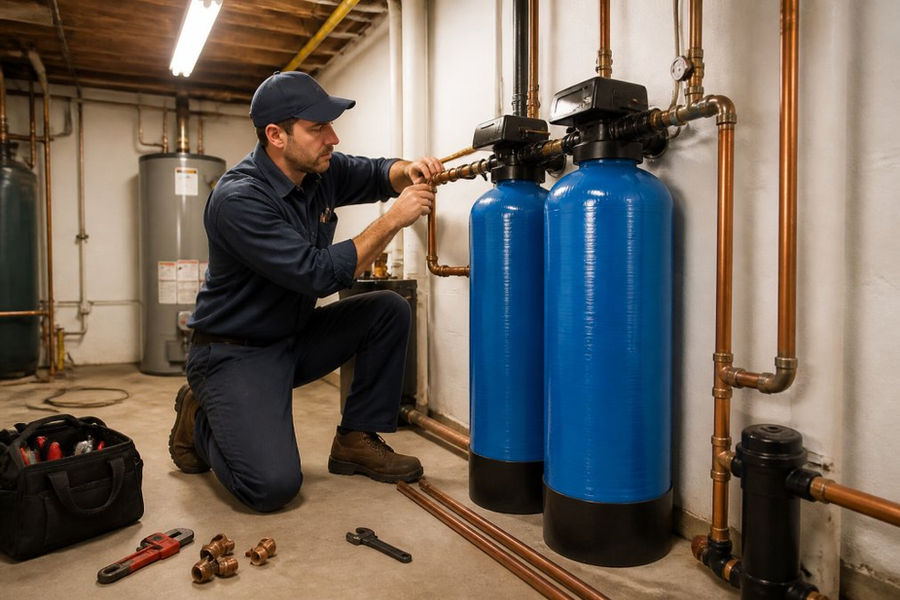
The critical distinction is treatment location. Point-of-entry systems protect the entire home's water supply, including washing machines and water heaters. Point-of-use systems treat water at a single fixture, typically the kitchen sink.
The Media Stack That Actually Removes PFAS and Heavy Metals
A whole-house unit that removes PFAS and heavy metals is not one filter, it is a sequence. The typical architecture, from inlet to outlet, looks like this:
Sediment pre-filter (5 to 20 micron). Captures rust, sand, and particulate that would otherwise blind the downstream media. Skipping this stage is the single most common reason expensive carbon or ion exchange media fails early.
Granular activated carbon (GAC) or carbon block. Adsorbs longer-chain PFAS (PFOA, PFOS) and many other organics. Carbon block offers tighter micron ratings and better contaminant contact; GAC offers higher flow at lower pressure drop.
Ion exchange resin (optional, for heavy metals). Swaps charged metal ions, lead, copper, cadmium, for sodium or hydrogen ions. Standard softening resin handles hardness; specialty resins (for example, those using iron-oxide or titanium-based media) target arsenic and other oxyanions that softening resin ignores.
Reverse osmosis membrane (whole-house RO only). A physical barrier that rejects PFAS regardless of chain length, plus heavy metals, arsenic, and total dissolved solids. Requires sufficient inlet pressure and produces reject brine.
A single-stage carbon cartridge cannot do all of this. When a product claims whole-home PFAS and heavy metal removal, the honest question is: which of these four stages does it actually contain, and what is each stage certified to reduce?
Flow Rate: The Trade-Off Nobody Puts on the Box
Every filtration stage adds resistance, and resistance costs pressure. A whole-house system's rated flow, expressed in gallons per minute (GPM), must meet your household's peak demand, not its average demand.
A useful rule of thumb: a typical home needs roughly 6 to 12 GPM at peak to run a shower, a dishwasher, and a washing machine simultaneously without a noticeable pressure drop. A single 4.5-inch by 20-inch carbon cartridge often flows 5 to 10 GPM when new, but that number falls as the media loads with contaminants. Add a sediment pre-filter, an ion exchange tank, and a whole-house RO membrane, and the cumulative pressure drop can push a system below the household's peak demand.
The practical consequences of undersizing are real: weak shower pressure, slow appliance fill times, and, more importantly, reduced contact time with the media, which lowers actual contaminant reduction below the certified rating. A system certified at a given GPM only performs to that certification when operated at or below that flow.
Whole-house RO compounds the issue. RO membranes typically recover only a portion of incoming water as permeate and reject the rest as brine, and they need a minimum inlet pressure (often 40 psi or higher) to function. That means a booster pump and a drain connection are frequently required, plumbing most homeowners do not have pre-installed.
Point-of-Entry vs. Point-of-Use Systems
Point-of-entry (POE) systems are the "whole house" category. They're ideal for addressing chlorine, sediment, scale, and taste issues across every fixture. The trade-off: pushing water through multiple filtration stages reduces flow rate, and high-capacity systems cost more upfront.
Point-of-use (POU) systems, like under-sink reverse osmosis, treat water only where installed. For PFAS and heavy metals specifically, POU reverse osmosis often outperforms whole-house carbon because the membrane provides a physical barrier and because the lower flow rate through a single fixture allows longer contact time. Many water treatment professionals recommend a hybrid approach: whole-house filtration for chlorine and sediment, plus under-sink RO for drinking and cooking water.
System Type | Best For | PFAS Reduction | Heavy Metal Reduction | Flow Impact |
Whole-house carbon | Chlorine, taste, odor | Moderate (with rated media) | Limited | Low to moderate |
Whole-house ion exchange | Hard water, some metals | Minimal | Good for charged metals | Moderate |
Under-sink RO | Drinking water, PFAS, metals | High | High | Single fixture only |
Whole-house RO | Whole-home PFAS and metals | High | High | Significant |
Pre-Filtration Is Not Optional
Carbon and RO media are expensive. Sediment and chlorine are what kill them early. A sediment pre-filter protects carbon from physical fouling; a carbon pre-filter protects an RO membrane from chlorine degradation (thin-film composite membranes are damaged by free chlorine over time). Getting the sequence wrong, for example, running chlorinated water straight into an RO membrane, shortens membrane life from years to months.
This is the part of whole-house design that separates a system that works for a decade from one that underperforms within a year. Before buying, ask the manufacturer for the recommended pre-filtration stack and the replacement interval for each stage, not just the primary filter.
Key Takeaway A whole-house system removes PFAS and heavy metals only when it stacks the right media in the right order, sediment, then carbon, then ion exchange or RO, and only when its rated flow meets your household's peak demand. Media without pre-filtration is a maintenance liability, not a solution.
Activated Carbon vs. Reverse Osmosis for PFAS
Activated carbon and reverse osmosis are the two workhorses for PFAS removal, and they work through completely different mechanisms. Carbon adsorbs PFAS molecules on to its porous surface. RO forces water through a semi-permeable membrane that rejects molecules larger than water itself.
How Carbon Adsorbs PFAS and Where It Fails
Activated carbon works because PFAS molecules have a fluorinated carbon tail that is attracted to the carbon surface. The longer the carbon chain, the stronger the attraction. That is why PFOA (eight carbons) and PFOS (eight carbons) are removed more effectively than shorter-chain compounds like PFBS (four carbons) or GenX (a short-chain replacement chemical).
Two practical consequences follow:
Chain length matters. A carbon filter certified for PFOA and PFOS reduction is not automatically certified for the full PFAS family. Short-chain PFAS slip through carbon more readily and require either more carbon, longer contact time, or a different technology.
Capacity depletes. Carbon has a finite number of adsorption sites. Once saturated, it stops adsorbing, and under some conditions can desorb previously captured contaminants back into the water. This is why the rated capacity (often stated in gallons) is not a suggestion; it is the point past which performance is no longer guaranteed.
Carbon block cartridges generally outperform granular activated carbon (GAC) for PFAS because the tighter structure forces better contact between water and media. The trade-off is higher pressure drop, which matters in a whole-house setup where flow rate is already constrained.
How Reverse Osmosis Rejects PFAS and Heavy Metals
RO does not care about chain length. The membrane rejects anything larger than a water molecule, which includes essentially all PFAS compounds and dissolved heavy metals like lead, arsenic, and chromium. That breadth is RO's core advantage.
The trade-offs are equally concrete:
Reject water. RO produces brine, typically a portion of incoming water is sent to drain rather than delivered as treated water. In a whole-house RO setup, that reject stream must be plumbed to a drain, which is a real installation requirement, not a footnote.
Pressure dependence. RO membranes need adequate inlet pressure to push water through. Low-pressure homes may require a booster pump.
Pre-filtration requirement. Chlorine degrades thin-film composite RO membranes. A carbon pre-filter upstream is mandatory, not optional.
Flow rate. Whole-house RO systems flow far less than carbon-only systems, which is why they are often paired with a storage tank and a repressurization pump.
Which One Removes Heavy Metals?
Carbon is not a heavy metal filter. It may incidentally capture some particulate-bound metals, but dissolved lead, arsenic, and chromium pass through. Heavy metal removal requires ion exchange resin or an RO membrane. This is the single most common misunderstanding in whole-house filtration: a carbon-only system marketed for "contaminant removal" will not address dissolved heavy metals.
The Certification That Backs the Claim
Performance claims for PFAS and heavy metals are only as good as the standard behind them. In the U.S., the relevant benchmarks are:
NSF/ANSI 53, health effects, including specific PFAS compounds (PFOA and PFOS) and heavy metals like lead.
NSF/ANSI 58, reverse osmosis systems, covering PFAS and a range of dissolved contaminants.
NSF/ANSI 42, aesthetic effects only (taste, odor, chlorine). A 42 certification says nothing about PFAS or heavy metals.
A product can carry 42 certification and still be marketed with PFAS language. The certification number on the label tells you which claims are actually verified. The NSF certification database lets you look up a specific model and see exactly which contaminants it is certified to reduce and at what capacity.
The Honest Recommendation
For homeowners weighing whole house filtration options, the practical split is this: carbon handles the whole house for chlorine, taste, and longer-chain PFAS; RO handles the drinking glass for the full PFAS family and heavy metals. A whole-house RO system can do both, but it brings reject-water plumbing, pressure requirements, and higher maintenance into the equation.
Pro Tip When comparing carbon filters for PFAS, ask for the micron rating and the specific PFAS compounds tested. A filter rated for PFOA and PFOS at a stated reduction level is different from one that simply says "reduces PFAS" without numbers. For heavy metals, ask separately, carbon alone will not do it.
Watch Out A filter that claims PFAS reduction without NSF/ANSI 53 or 58 certification has no independent verification behind that claim. Relying on an uncertified product for health-related contaminant removal means you have no way to know whether it actually works in your water.
NSF/ANSI 53 Certification for PFAS
NSF/ANSI 53 is the certification standard that matters most when evaluating PFAS claims. It's the benchmark for filters designed to reduce health-related contaminants, and it now includes testing protocols for specific PFAS compounds including PFOA and PFOS.
A filter carrying NSF/ANSI 53 certification for PFAS has been independently verified to reduce those compounds to below the certification threshold. That's the difference between a marketing claim and a tested result. The NSF certification database lets you look up any product by manufacturer and confirm exactly which contaminants it's certified to reduce.
NSF/ANSI 58 covers reverse osmosis systems specifically. If you're evaluating an RO unit for PFAS and heavy metals, look for 58 certification alongside 53.
The certification also specifies capacity. A filter certified to reduce PFOA might carry a rating stated in gallons before replacement. Exceeding that rating voids the performance guarantee, even if the filter still "works" in the sense that water flows through it.
How to Test Home Water for PFAS and Heavy Metals
Testing is the only way to know what's actually in your water, and PFAS testing requires a specialized lab. Standard home test strips don't detect PFAS at the parts-per-trillion levels where health concerns begin.
Start with your municipal water quality report if you're on city water. Utilities are required to publish annual Consumer Confidence Reports listing detected contaminants. These reports cover regulated contaminants, though PFAS reporting requirements have expanded in recent years. The EPA's PFAS resources explain current testing and reporting requirements for public water systems.
For private wells or for confirmation beyond what the utility reports, Bevilacqua Pure can facilitate a certified laboratory test. We use labs using EPA-approved methods for PFAS analysis. Heavy metals testing is more widely available and less expensive.
What most guides miss: testing before buying is the step that prevents wasted money. A homeowner with clean water and no PFAS detection may only need basic carbon filtration for taste and chlorine. A homeowner with detected PFAS at concerning levels needs a different system entirely. Bevilacqua Pure offers free in-home water testing to establish what a home's water contains before recommending any equipment.
Filter Maintenance, Flow Rate, and Cartridge Lifespan
Every filtration system degrades with use, and the maintenance schedule determines whether it keeps working. Carbon filters typically need replacement every six to twelve months depending on water volume and contaminant load. RO membranes last longer, often two to three years, but their pre-filters need more frequent changes.
Cartridge lifespan depends on three factors: the volume of water treated, the concentration of contaminants, and the filter's rated capacity. A family of five processing hundreds of gallons weekly will exhaust a cartridge faster than a single occupant.
Flow rate is the trade-off nobody mentions upfront. Each filtration stage adds resistance. A whole-house system with sediment, carbon, and ion exchange stages may drop household water pressure noticeably, especially during simultaneous use like a shower running while the dishwasher fills. Check the system's rated flow in gallons per minute against your household's peak demand.
Key Takeaway Match filter replacement to actual water usage, not just the calendar. A filter rated for a set number of gallons may need changing sooner in a high-contaminant household. Track your replacement dates and test water periodically to confirm the system is still performing.
Installation Options: DIY vs. Professional
Whole-house filtration installation involves cutting into the main water line, which is where most homeowners should pause. A point-of-use under-sink filter is a reasonable DIY project for someone comfortable with basic plumbing, but certainly something Bevilacqua Pure is ready to help with. A whole-house system is a different category of work.
Professional installation addresses several things a DIY approach often misses: proper sizing for the home's plumbing and water pressure, correct sequencing of filtration stages, code-compliant connections, and drainage for RO reject water. Mistakes at the main line can cause leaks, pressure problems, or contamination if the system isn't installed with proper backflow prevention.
The pre-filtration question matters here too. RO membranes require sediment and carbon pre-filters upstream to protect them from chlorine damage and physical fouling. Getting that sequence wrong shortens membrane life substantially.
For homeowners who want the work done correctly the first time, Bevilacqua Pure provides professional installation services with a pressure-free consultation process, starting from the water test rather than a preset package.
Conclusion
Understanding what whole house filtration removes comes down to matching media to contaminants: carbon for PFAS adsorption, ion exchange or RO for heavy metals, and proper certification to verify both. The systems that work are the ones designed around actual water test results, not generic claims.
If you're unsure what's in your water or which treatment approach fits your home, Bevilacqua Pure offers free in-home water testing, plain-language explanations of your results, and customized solutions built around your specific water conditions. Book your free water test and get clear answers before you spend a dollar on equipment.
Frequently Asked Questions
What type of water filter is best for removing PFAS?
For PFAS removal, NSF/ANSI 53 certified filters using activated carbon or reverse osmosis are the most effective. Activated carbon filters work well for many PFAS compounds, while reverse osmosis systems can remove a broader range of perfluoroalkyl and polyfluoroalkyl substances. Look for certification specifically listing PFAS reduction, and verify the filter meets NSF/ANSI 53 standards. Combining whole house filtration with a point-of-use RO system for drinking water offers the best protection.
Do carbon filters remove heavy metals from water?
Standard activated carbon filters do not effectively remove heavy metals like lead, arsenic, or chromium. To reduce heavy metals, you need a filter with ion exchange resin, KDF media, or reverse osmosis. Some NSF/ANSI 53 certified carbon filters are designed with specialized media to target specific metals. Always check the certification for the exact contaminants the filter is tested to remove, and test your water first to know which heavy metals are present.
How do I know if my water contains PFAS or heavy metals?
The only way to know for certain is through water quality testing. You can start with your municipal water quality report, which lists regulated contaminants but may not include all PFAS compounds. For a complete picture, use a certified third-party lab that tests for PFAS at parts per trillion levels and heavy metals. Professional in-home water testing can also screen for common issues like lead, arsenic, and manganese, giving you a clear baseline before choosing a filtration system.
Do I need a reverse osmosis system to remove PFAS?
Not necessarily, but reverse osmosis is one of the most reliable methods for PFAS removal. Activated carbon filters certified to NSF/ANSI 53 can also reduce PFAS, though their effectiveness varies by compound and filter quality. For whole house protection, a point-of-entry carbon system handles general contaminants, while a point-of-use RO system under the kitchen sink provides an extra barrier for drinking and cooking water. The right choice depends on your test results and how much PFAS is in your water.


Comments